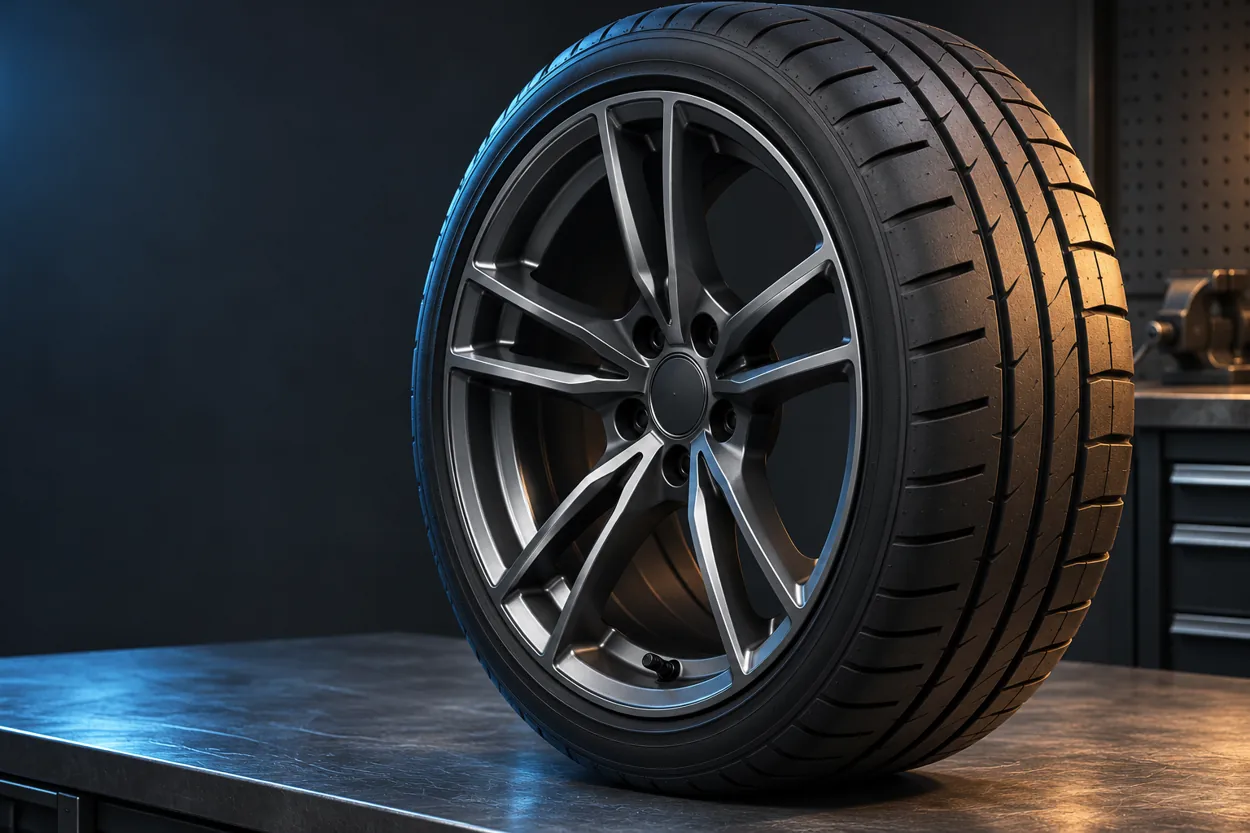
How tall is a 205/55R16 tire?
A 205/55R16 measures 631.9 mm tall on paper, or 24.88 inches. Only 16 inches of that height belongs to the wheel. Each sidewall contributes another 112.75 mm. If you are checking the height of an exact tire before an order, look up the make, model and size on the tire maker’s specification sheet. Two products bearing the same size code can have slightly different published diameters.
How to read the three numbers
The first number in 205/55R16 is the nominal section width in millimeters. This describes the tire across its sidewalls. The second number is an aspect ratio. Multiply 205 by 0.55 to get the nominal height of one sidewall. R indicates radial construction, and 16 is the wheel diameter in inches at the tire bead. A suffix such as 91V adds a load index and speed rating. Record those separately when identifying a replacement. Michelin’s guide to sidewall markings
You can check the calculation yourself. Multiply the rim diameter in inches by 25.4 to get millimeters. Add twice the sidewall height to get the tire’s overall diameter. Multiply that diameter by π for the theoretical distance traveled in one unloaded revolution. Divide any result in millimeters by 25.4 to express it in inches.
How do I convert 265/70R17 to inches?
A 265/70R17 is approximately 31.61 inches tall and 10.43 inches wide on a 17-inch wheel. The sidewall is 265 × 0.70 = 185.5 mm high. Add two sidewalls to the 431.8 mm wheel and you get 802.8 mm of overall diameter. Dividing by 25.4 gives the height in inches.
A listing such as 31×10.50R15 also gives diameter and width in inches, but the last number calls for a 15-inch wheel. It cannot mount on the 17-inch wheel in this example. For a truck tire, type the full size from the listing, including the rim diameter, into Compare a second tire size above. Check the tire maker’s actual dimensions and approved rim widths for the specific model before ordering.
How to use the similar-size shortlist
Start with a single baseline. The closest outside diameter is useful when you want to preserve the distance traveled per revolution. Use the wheel-diameter filter if you already own the wheels. A 195/65R15 and a 225/45R17 both fall within 3 mm of a 205/55R16 in outside diameter, but each requires its own wheel diameter. Select a candidate to compare the sidewalls and the expected speedometer change. Check the approved rim width and service ratings separately.
What a larger wheel changes
The tire outside the wheel can stay nearly the same height even when the wheel grows by an inch. Switching from 205/55R16 to 225/45R17 adds 25.4 mm of wheel diameter. The two shorter sidewalls together give back 23.0 mm. The whole assembly grows just 2.4 mm in diameter. The difference between these two sidewalls is more noticeable than the difference between the two outer circles. See both sizes and their speedometer readings
Use the measurement that answers your question
- To identify a size for your own car, start with the driver’s door label. Enter the listed front or rear size for the axle you are checking. Look up a vehicle example or use your placard
- To find how tall a size is in inches, use the diameter column. Sidewall height covers just the rubber between the wheel and the tread on one side. Browse the tire size chart
- To see how a size alters the distance traveled at a given indicated speed, put the original size first and the candidate second. Compare two tire sizes
- To see how a different wheel moves toward the fender or the suspension, record its width and signed offset. Tire diameter alone leaves that question open. Calculate wheel offset and position
Which numbers should go to the tire shop?
Take the original front and rear size codes, the proposed tire’s full service description, the wheel width and offset, and the exact tire model. A size code supplies nominal geometry. A model-specific data sheet adds the approved rim-width range and measured dimensions. The vehicle manufacturer supplies its permitted configurations, including any requirements for axles with different tire sizes. NHTSA’s tire selection guidance
Common questions
Can I use the tire size calculator on my phone for free?
Yes. Open this page in your phone’s browser and enter the size printed on the sidewall. You can compare as many pairs as you like without an account, app or photo upload. To send a pair to your installer, open the detailed comparison and copy its share link.
Does 225 mean the tread is 225 mm wide?
225 is the nominal section width, measured across the sidewalls. The tread that meets the road has its own width and shape.
Will the calculator tell me if the tire rubs?
It estimates changes in the size of the tire envelope. Actual clearance also depends on your wheel, suspension travel, steering angle and the measured shape of the specific tire.
Why can my tape measure give another diameter?
The code gives nominal dimensions. The wheel used to mount the tire, the product design, inflation, tread wear and load can all affect what you measure. Use the manufacturer’s data for the exact product.